TABLE OF CONTENTS
- 1. What is the General Ledger?
- 2. How Does It Work?
- 3. Chart of Accounts
- 4. Journal Entries
- 5. A Practical Example
- 6. How the General Ledger Builds Your Reports
- 7. Key Benefits
1. What is the General Ledger?
The General Ledger, commonly referred to as the GL, is the master record of every financial transaction in Hana Accounting. Think of it as the central hub where everything comes together. Every invoice, payment, bank transaction, refund, gift card, tax entry, and adjustment is recorded here.
The General Ledger is the foundation for the two most important financial reports in Hana Accounting:
Profit and Loss Report: Summarises your revenue and expenses over a period of time.
Balance Sheet: Shows what your business owns and owes at a specific point in time.
Because the GL contains all account types, including revenue, expenses, assets, liabilities, and equity, it is effectively the combined source for both the Profit and Loss report and the Balance Sheet.
2. How Does It Work?
Every time a transaction happens in your shop, it is automatically recorded in the General Ledger. Here is where each type of entry comes from:
POS Invoices: Sales, delivery income, and taxes are automatically posted when an invoice is created.
Payments: Recorded against the bank or undeposited funds and matched to the corresponding invoice.
Bank Transactions: Imported from your bank statement to record deposits, withdrawals, and fees.
Refunds and Adjustments: Recorded to reduce revenue or log refund expenses.
Gift Cards and Store Credit: Recorded as a liability until the customer redeems them.
Manual Journal Entries: Used for special adjustments that do not come through automatically. More on this in Section 4.
3. Chart of Accounts
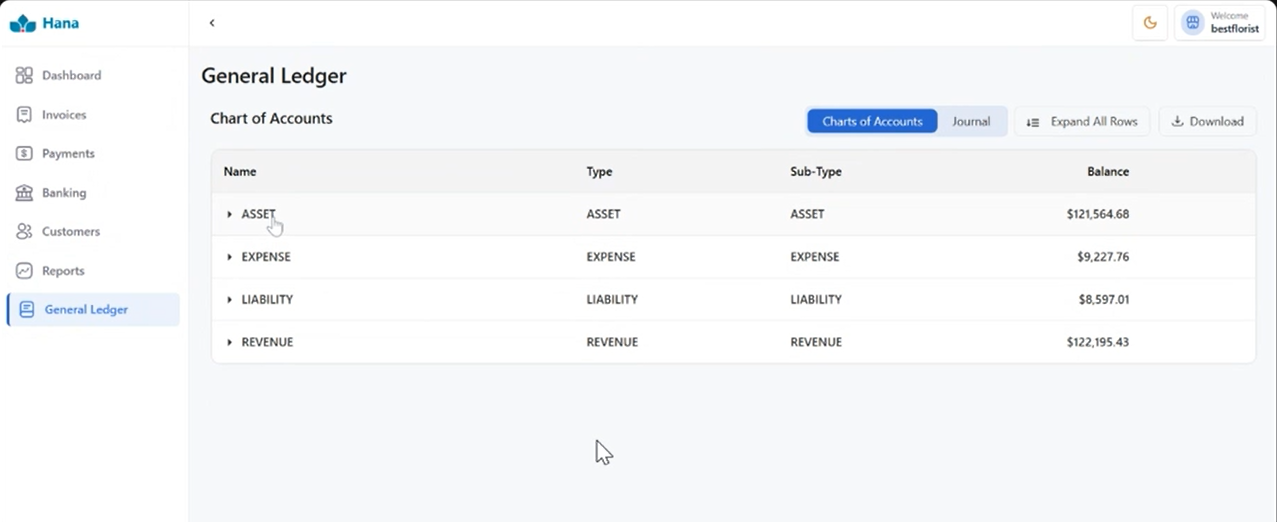
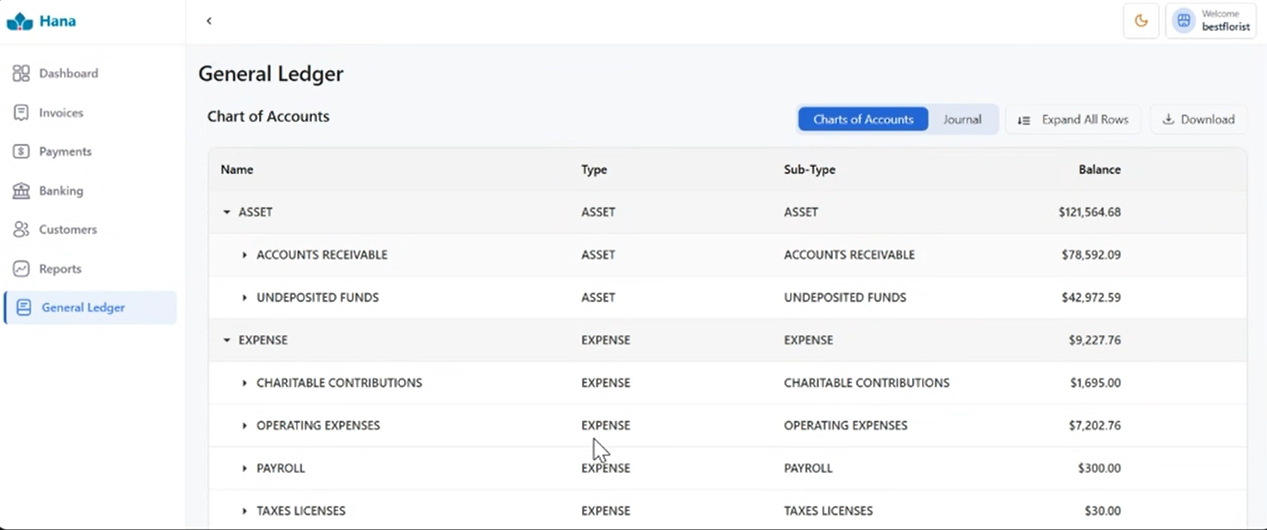
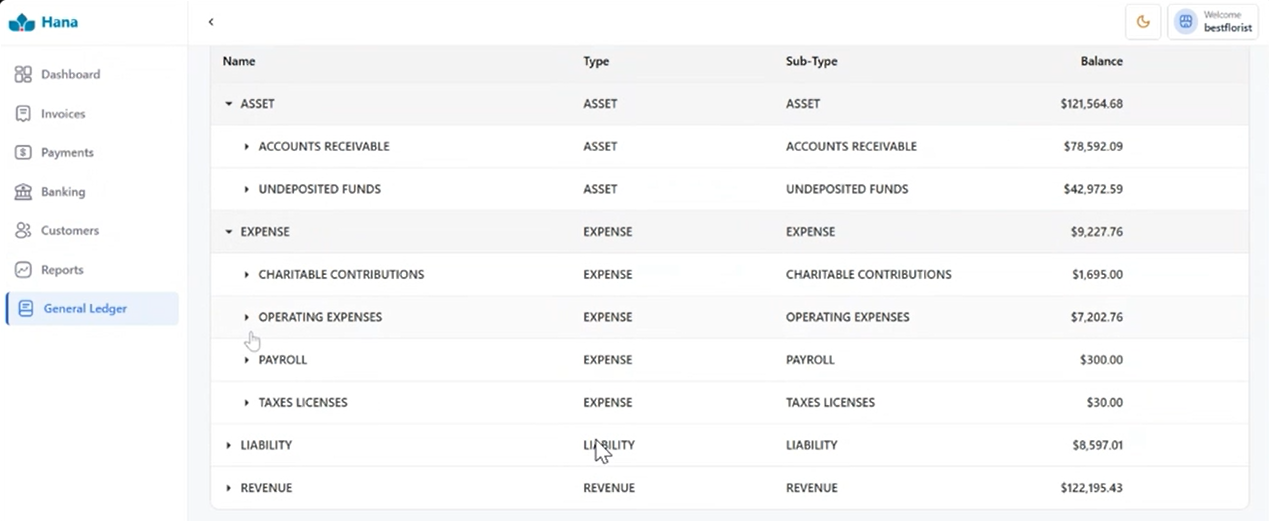
The Chart of Accounts is the structured list of all accounts used in the General Ledger. It organizes every transaction into a category so your reports are accurate and easy to read. Here is how it is structured:
Assets - What Your Business Owns
Cash and Bank, Accounts Receivable, Undeposited Funds (Cash, Checks, Credit Card, POH), and Inventory.
Liabilities - What Your Business Owes
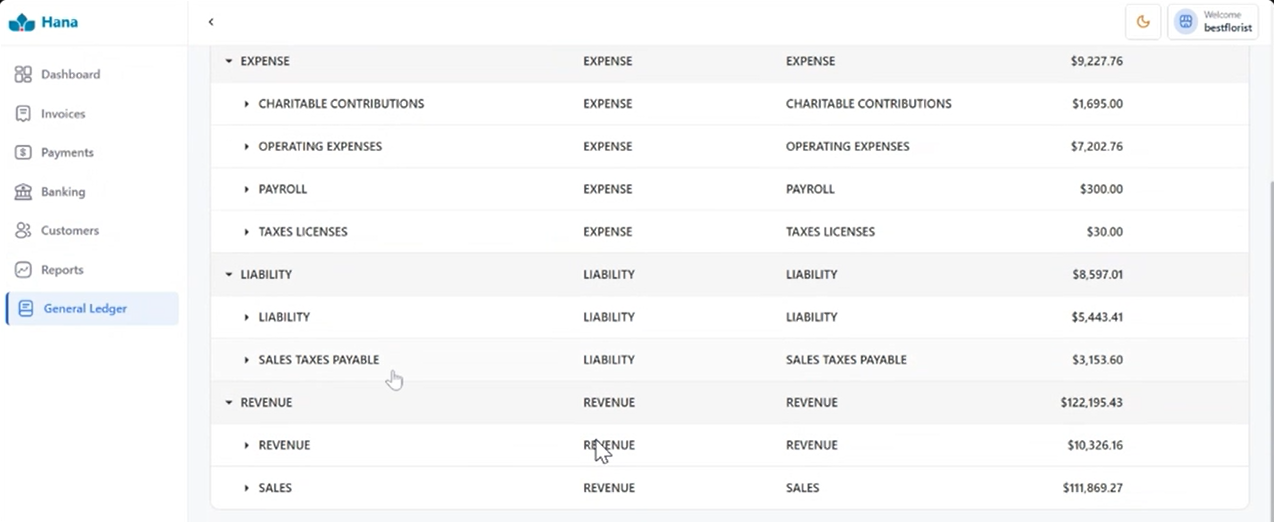
Accounts Payable, Sales Taxes Payable, Gift Card and Store Credit balances, Loans, Wire Out, and FTD Payable.
Equity - The Owner's Share
Owner's Equity and Retained Earnings. This represents the value that belongs to you as the business owner.
Revenue - Money Coming In
Sales, Delivery Income, and Other Income.
Expenses - Money Going Out
- Cost of Items Sold, Payroll, Rent, Bank Fees, Donations, and other Operating Expenses.
Special Accounts Worth Knowing:
- These accounts come up frequently and are worth understanding clearly:
Undeposited Funds: Money you have collected from customers that has not yet been deposited into your bank account.
Gift Card and Store Credit: Payments made in advance by customers. These are recorded as liabilities because the product or service has not yet been delivered.
Sales Taxes Payable: Tax money collected from customers that has not yet been paid to the government. It is not your income; it is held temporarily until it is submitted.
Wire Out and FTD: Bank withdrawals and partner transfers related to wire services, recorded as liabilities or expenses depending on the nature of the transaction.
Bank Fees: Fees deducted by the bank from your deposits, recorded as expenses.
4. Journal Entries
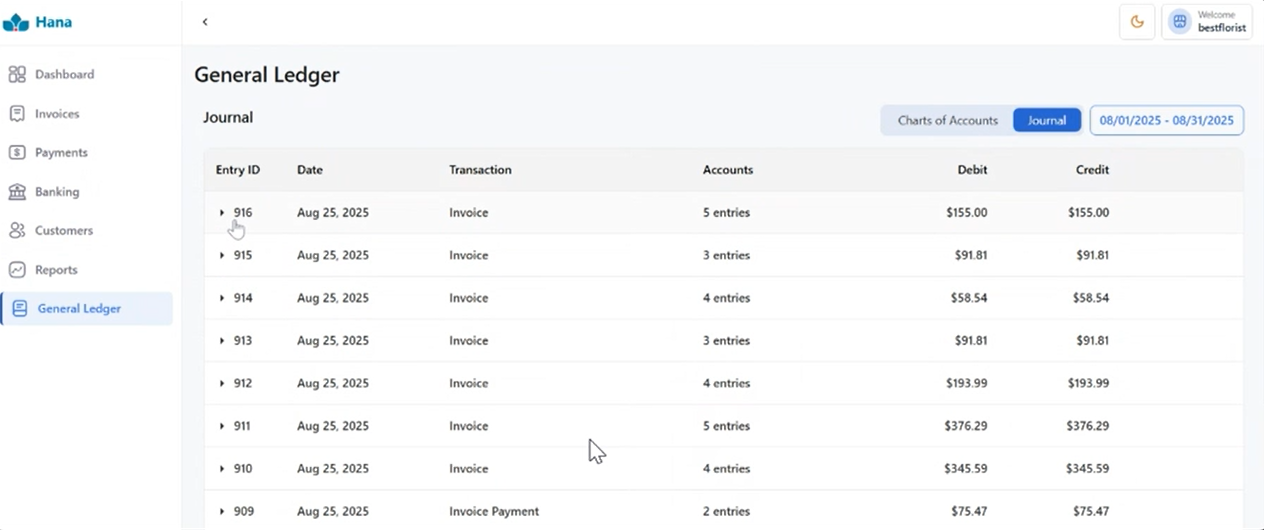
A Journal Entry is a manual entry used to record debits and credits that do not come through automatically from POS, payments, or bank imports.
A debit and a credit are the two sides of every financial transaction. Every time money moves, one account is debited (increased) and another is credited (decreased). This is called double-entry accounting, and it ensures that your books always balance.
Journal entries are used for:
Corrections: Fixing a transaction that was posted to the wrong category.
Adjustments: Recording things like depreciation or accruals. Depreciation means spreading the cost of an asset over time. Accruals mean recording income or expenses before the actual cash moves.
Write-offs and Donations: Recording amounts that are being cleared from the books.
Splitting Deposits: For example, separating a deposit that includes both sales income and a bank fee deduction.
Every journal entry must follow the double-entry rule. Every debit must have a matching credit so the books stay balanced.
5. A Practical Example
Here is how a single sale flows through the General Ledger:
An invoice is raised for $200 in sales, $10 delivery fee, and $10.50 in tax. Total invoice value is $220.50.
The GL records:
Debit Accounts Receivable $220.50 (customer owes this amount)
Credit Sales $200 (income earned)
Credit Delivery Income $10 (delivery fee earned)
Credit Sales Tax Payable $10.50 (tax collected, to be paid to the government)
The customer then pays $220.50 by card. The bank receives $215 after a $5.50 bank fee is deducted.
The GL records:
Debit Bank $215 (amount actually received in the bank)
Debit Bank Fee Expense $5.50 (fee charged by the bank)
Credit Accounts Receivable $220.50 (invoice is now cleared)
Everything balances. Nothing is missing.
6. How the General Ledger Builds Your Reports
The General Ledger is what powers your financial reports. Here is how:
Profit and Loss Report: The GL adds up all revenue accounts and subtracts all expense accounts to give you your Net Profit or Loss.
Balance Sheet: The GL checks that Assets equal Liabilities plus Equity, giving you a snapshot of your business's financial position.
Closing Entries: At the end of each period, the Net Profit from the Profit and Loss report is moved into the Equity section of the Balance Sheet. This keeps your reports accurate going into the next period.
7. Key Benefits
Single Source of Truth: Every transaction across invoices, payments, banking, and adjustments is captured in one place.
Accuracy: Double-entry accounting ensures there are no missing records or imbalanced books.
Transparency: You can audit your income, expenses, and taxes clearly at any time.
Tax and Compliance Ready: Clean and complete records mean your books are always ready for tax filing or financial reporting, without any last-minute scrambling.
Was this article helpful?
That’s Great!
Thank you for your feedback
Sorry! We couldn't be helpful
Thank you for your feedback
Feedback sent
We appreciate your effort and will try to fix the article